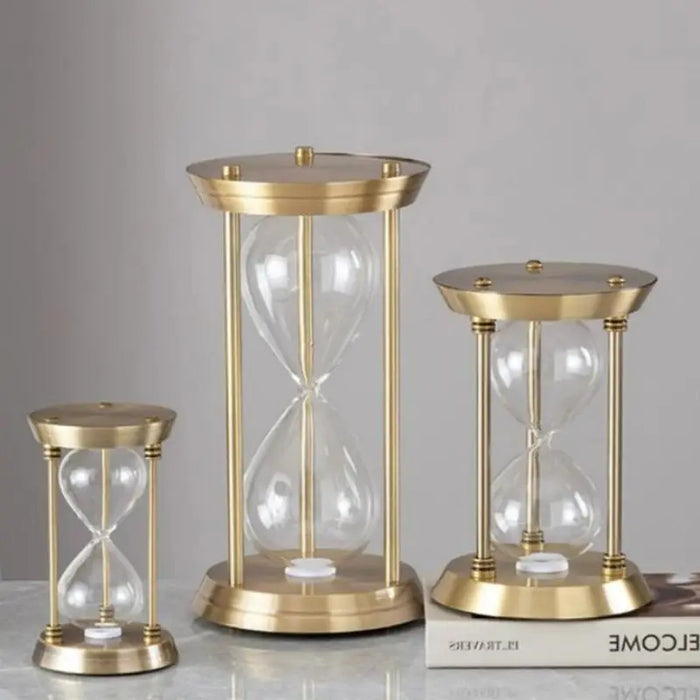
The hourglass measures time — but that's not really why we buy one anymore.
You have to be honest: no one today uses a hourglass to cook eggs in the hull or time their chess parts. The watch, the phone, the kitchen timer have been taking care of all these functions for a long time. If the hourglass comes back in strength in contemporary interiors, it is for other reasons — its intrinsic beauty, the fascination of the sand flowing, and something it says about time, patience, and contemplation in spaces where everything often goes very quickly.
At Amberkiln, our collection of decorative swords covers several formats and styles: small glass and metal office sanders, wooden sands and glass to be placed on a console or buffet, large sands as a separate decorative piece, brushed gold sands, matt black, chrome, white sand, coloured sand or metallic sand — varying flow times from a few minutes to a few minutes. Half an hour. Objects that find their place in an office, a living room, a bedroom or a library with the same ease.
Decorative sword or functional hourglass?
Both are not incompatible — but we must distinguish between the uses to make the right choice.
One functional hourglass has a precise and calibrated flow time — 3 minutes, 5 minutes, 10 minutes, 30 minutes. It is used to speed up an activity: a focused working session, a meditation time, a speaking time in a meeting, a board game. These sand blades are often more robust, with finer and more regular sand, and perfect symmetry of both bulbs for accurate flow.
One pure decorative hourglass can afford to be less precise — which often opens up more freedom in terms of design. Light bulbs can be asymmetric, coloured or metallic sand, more architectural structure. These swords are not there to measure time but to occupy space and capture the look.
Most of our models work in both registers at once — accurate enough to be useful, beautiful enough to be exposed. It is this balance that makes it complete objects.
Materials and finishes: what hourglass for what interior?
The brushed gold metal and glass hourglass is the most common model in contemporary interiors looking for a touch of warmth and preciousness. The brushed gold metal naturally combines with the transparent glass of the bulbs, creating an object that is both light and precious. These models work in virtually all interior styles — from minimal contemporary to hot bohemian.
The wood and glass hourglass is more organic and warmer. The wood — oak, bamboo, walnut — gives a stable and natural base that contrasts with the transparency of the bulbs. These models are particularly suitable for Scandinavian, natural or wabi-sabi interiors. Set on a wooden desk, a wood-structured hourglass fits so naturally that it is finally forgotten — until it is turned over and the sand begins to flow.
The black matt metal hourglass is the most contemporary and assertive option. Its dark and geometric structure creates a strong contrast with the white or golden sand that flows. It is an object that assumes its graphic character and is integrated into contemporary interiors that do not fear daring.
Returning an hourglass: a gesture that stops time
There's something almost hypnotic about watching a hourglass run out. The sand, grain by grain, passes from one ampoule to another according to an implacable and gentle logic at the same time. We can't press it, we can't stop it — we can only look at it. In a world that values permanent acceleration, this object silently embodies the opposite: time that passes at its own pace, without being able to accelerate it or slow it down.
Maybe that's why we buy one — not to measure time, but to contemplate it. The hourglass is one of the few decorative objects that invites you to stop. it was on a desk, and recalled that a working session had a limit. Set in a living room, it invites to sit and watch. Placed in a room, it gently punctuates the end of a day. It's a lot for such a simple object.
Sablier and globe: two objects that speak to each other
The hourglass and the globe share something essential: both evoke dimensions that the object itself does not contain — time for one, space for the other. Gathering together on the same desk or shelf, they create a silent conversation around these two basic coordinates of every existence. It is a composition that has meaning, and the interiors that practice it often do it instinctively, without theorizing — because it just works.
Explore Related Collections
Continue browsing Home Decor, Living Room, Bedroom, Dining Room.